The Gnostic Teachings of Christ: Descent into Hell
Michael Ebbinghaus • December 3, 2025
The Link Between Gnostic Christianity and Jungian Psychology
Listen to this Article Narrated by the Author
In the first part of this article, we explored the esoteric teaching of Christ to follow His example and awaken to a living relationship to the Father through direct experience of Oneness or God, otherwise referred to as mystical experience or mystical union. We also discussed how it is natural for the esoteric teachings
of any tradition to tend towards calcification into dogma.
You can find the first article here.
There is a reason for this natural tendency towards dogma. As logical beings we want to take the most direct route, and thereby go about searching for it out here. Who else has been there? What can we learn from them? Most importantly, what techniques do I need to learn?
And to be sure, there is a place for techniques in any seeker, as they can help to provide crucial clarity and discipline with which to navigate the journey of life, as well as prepare us for initatory experience.
But there is nothing that we can “do” to invite our relationship with ourselves.
With this, there is always an element of fate and circumstance. An event or, more often, a confluence of events in an indivdual’s life brings them to the place they can no longer avoid.
It begins in a moment, and the practices are fine so long as they’re used as means and not as ends.
One needs mental clarity, endurance, a readiness to let go, a curiosity about all manner of experience, internal and external.
There is another reason why we avoid the internal path, the path that Christ recommends. If accumulating practices and knowledge is the “easy” route, then the route of going into oneself and meeting the Father, or what Carl Jung would call the process of individuation, is an incredibly arduous one. It entails descending, like Christ, into the Underworld, into Hell and death.
This is the redemptive principle at work, the injunction from wisdom tradition after wisdom tradition that we must “die before we die.”
This is to awaken to the undying and unborn nature within one’s own being, the fount of all manifestation from which all being arises, present everywhere, at all times, and in all things. This is what Christ means by being “One with the Father,”
and Carl Jung defined it as the “Uroffenbarung”
or “primordial experience.”
It entails not a lofty escape from all the bitter mudiness of our humanness, but descend straight through and into it, leaving nothing behind.
The methods, practices, and tenets of the scriptures, of any scripture, can only help us to meet God, they are not God themselves,
and to practice this unconsciously is to commit the ultimate hybris.
While we may first hear God in choruses of angels, heavenly music, and beatific experience, this fundamentally serves the task, too, of hearing Her in the deep burblings of gladular secretion and corpuscular action, in the grotesqueries of decay, and the formidable darkness and overwhelm of the dark reaches of the Earth.
As well as perniciously in our most embarassing and intractable human problems such as relationship issues and addictions.
We must look for God in the places we are least willing to look, most apt to deny His presence, for where is God not? It lays deep in our entrails, the Spark that gave rise to It All.
Until you can see the Heaven in Hell, your conscience will beleaguer you towards that higher awareness, and
you will call it the Devil.
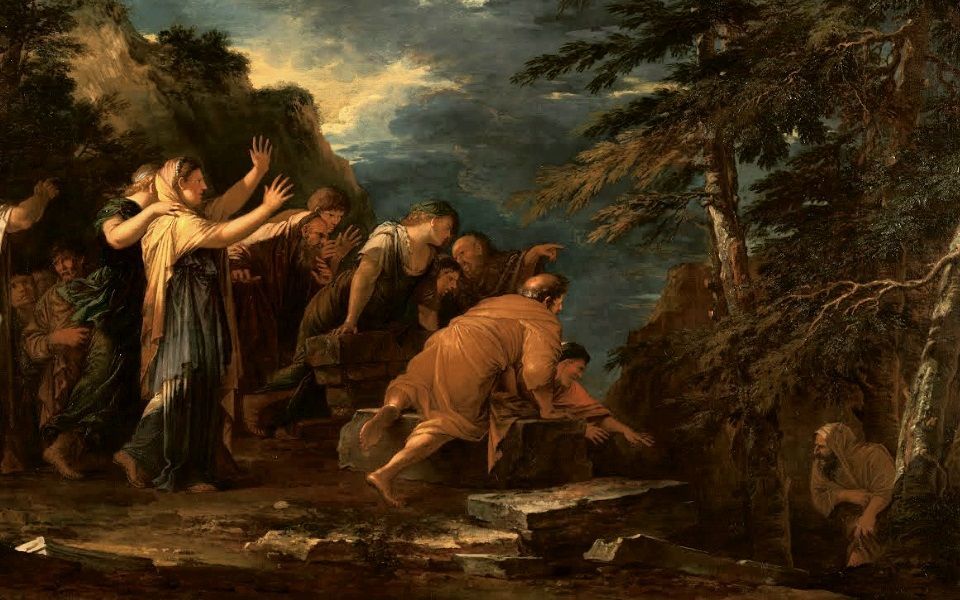
The Descent into Hell
Carl Jung starts to enter into the picture here because his psychology was modeled on Gnostic teachings, and moreover, Jung himself was a living Gnostic (Kingsley, 2018). The idea of God as the Devil
points us straight to Jung’s work regarding the Shadow
– those parts of ourselves we abhor identification with and exile to the wastelands of our awareness where they inevitably sew the seeds of our failures.
The ardent philanthropist overextending themselves financially and energetically to compensate for a fundamental lack of self-worth, the murderer who tried to physically kill off something in himself externalized to another human being, the priest who exercises his abhored sexuality in the secrecy of a child’s trust… these are all examples of manifestations of the shadow. Rather than indicate our sordidness, they lead us to something which cannot be reckoned with
and therefore is the guiding principle.
In all of these examples there is potential for extraordinary healing and wholeness; redemption and re-union may take place.
"Until you can see the Heaven in Hell, your conscience will beleaguer you towards higher awareness, and you will call it the Devil."
And so it is with our own proclivities, our own secret nature, our own unmentionables. The place where you are beset by an unbearable contradiction – that thing that you both most want to stop doing and least want to end – is where the numinosum, this secret nature or inner man/woman/spirit, seeks to enter you.
These insights are not limited to Gnosticism. It shares many of its foundations with indigenous wisdom traditions, with Sufi Islam and Tibetan Buddhism. In all of these traditions, there is a descent.
What is the descent?
Descent as Initiatory Experience
The descent is the departure from all preconceived knowledge
and the complete unraveling of individual identity.
Once the tasks of childhood and adolescence have been accomplished and the individual has found a stable enough place in a living culture, they must now learn the truth about all of it – go back to the living past from which they and It emanate.
This is the role of initiatory experience. In order to meet one’s fullness, one must arrive at an experience of uncontestable, unreckonable, unspeakable reality, which includes their unique place in it, the mythopoetic role they were born to play in the Kosmic ecology.
This also entails meeting with the transpersonal realm of suffering.
Of witnessing viscerally the enormous pain of Humankind, so lost in a world where they were meant to be righteous rulers.
This is very inimical in our day when we grow timid of holding any hard or fast distinctions or definitions. We are careful about people’s ideas and identities (did you catch that one?). Experience, of course, flows through the lens of the individual. And we have thrown out the pearls of our historical wisdom which directs us to the source that flows through that lens, that direct observation of this source, of God, is achievable.
Unfortunately, we denied ourselves such value long ago.
The form that we build to occupy our place in our culture
is properly contextualized through initiatory experience
– through experience of uncontestable Reality, the primordial experience or Uroffenbarung – giving space to other parts of the personality to grow. This is what the Gnostics referred to as gnosis, or knowing, what the alchemists would come to discover in their art of sacred union or hieros gamos, and the sacred process that Carl Jung
described as individuation.
Because the form that we inhabit:
the body, the personality, the character – is only the crudest yet clearest representation of the Divine Will in matter, the glorious peak of an incredible iceburg. Who we have become cannot possibly be who we are becoming, and for those that try to hold on the suffering grows greater and greater as age accumulates. We must meet with the parts of ourselves which we deny, to ourselves and to God. Like our prophetic tradition, we too must evolve.
To contend with the unseen parts of ourselves has always been a tremendous task, one that required a consciousness that was differentiated enough to see it. The Gnostics and alchemists had no idea of physical matter
– the unseen world
held an uncontended validity
in their time. Historically, Christ serves humanity as the harbringer of new collective awareness
– a process that will take millennia to unfold. In our world
where the unseen holds an uncontended invalidity
– written off as mere scrap – the task is equally as arduous, as so many of our ideas about who we are derive from our parent culture(s).
Many of our ideas concerning ourselves stem from this materialism, from this assertion that the material world
– i.e. what can be gleaned with the senses and instruments - is what constitutes the fundamental base of reality.
As such we are apt to regard ourselves as machines. It is why many are apt to define their moods as “dopamine depletion” or to relegate themselves to a syndrome.
From the start, this process is already tremendously painful,
made more difficult by the fact that it arrives naturally when life is in calamity. The descent is a death and rebirth cycle depicted in our ancestral myths the world over as dismemberment and disembowelment, obliteration in fire and rising out of the ashes like the Pheonix, and death and resurrection of the God-Man.
Of course, in our myth, the God-Man is crucified.
One is out of one’s depths and all previous modes of adaptation fail to accommodate the influx from the Unconscious. It is unbearable, insolvable, and yet it is born.
"Rather than indicate our sordidness, [the Shadow] leads us to something which cannot be reckoned with and therefore is the guiding principle. In all of these examples there is potential for extraordinary healing and wholeness; redemption and re-union may take place."
How this looks in lived experience is that the previous structures that had given form and meaning in an individual’s life have given way, often during a time of abrupt transition - deaths, breakups, job losses, injury, etc. You are “up Shit Creek without a paddle.”
This throws one into the pit of one’s own being, all of one’s unreconciled conflicts, the patterns of identity
laid down long ago that served specific purposes particular to an environment
which we have now recreated in our present day
– no matter how far we may be physically removed from our past.
This is where the Uroffenbarung is to be found.
If the individual is to climb out of this morass, they must find something within the darkness of this night,
this great fissure which has opened up in their being through which now pours unbearable psychic content.
Because amongst that content is everything the individual needs:
all the love they feel they never received, the nurturing hand of compassion eloquently married to the hand that guides and discerns, all the threads that bring together that individual’s destiny – their place in the immortal Universe alongside their temporary manifestation in the world of forms.
The Collective Descent
There is something of a conundrum here: on the one hand, the process of descending into one’s own being seems to be made more difficult by the fact that we are currently experiencing a Collective Descent. On the other, the Collective Descent sets a fertile ground for the descent and individuation both of individual persons and communities. Our largest impediment is the underresourcing of communities,
which have long stood the barage of environmental pollution, criminal medical practices, educational sabotage, financial subterfuge, as well as many forms of discrimination.
If we find the physical plane lacking, our spiritual environment is considerably more anemic.
They are contaminated with ruthless self-improvement, that inevitable sadomasochism of the Messiah complex.
The routes to initiation are narrow, and even when they are successful, there is not necessarily a shared local commuity to return that to. We have the grand task of navigating the deeply impersonal community, this notion of all peoples and nations on earth – while also sewing the seeds for deeper community within our specific environs.
"We, of course, do not see the course of history and the myriad magical spells which were cast in order for it to be natural for us to look at a world of stuff rather than a world of spirits."
The one ethos we have had: the American Dream, which at its core contains the admirable and widely cherished ideal of personal soverignty, has grossly deteriorated. It can no longer maintain the illusion, revealing itself more and more to be a spectre.
The ways in which people have oriented their lives have, for the most part, ultimately failed them. The energy within the Unconscious is growing,
with all indications leading to some kind of open conflict among either major world powers or transnational events involving the human majority and the small class of ultra-wealthy elites.
Yet this is fertilizer for growth
– physical, emotional, mental, and spiritual. We can imagine there is a similar imperative in the process of an acorn becoming an oak, something of a psychic pressure which it experiences. The deeper down its roots plunge, the higher and stronger its canopy. We must imagine that there is some sort of hunger or pain which drives the oak, helps it to make that desperate push through the shell of the acorn.
In a strange twist of the marshmallow experiment, now being given to all Humankind, we have the interesting choice of experiencing an unbearable Hell now or an even more unbearable Hell later.
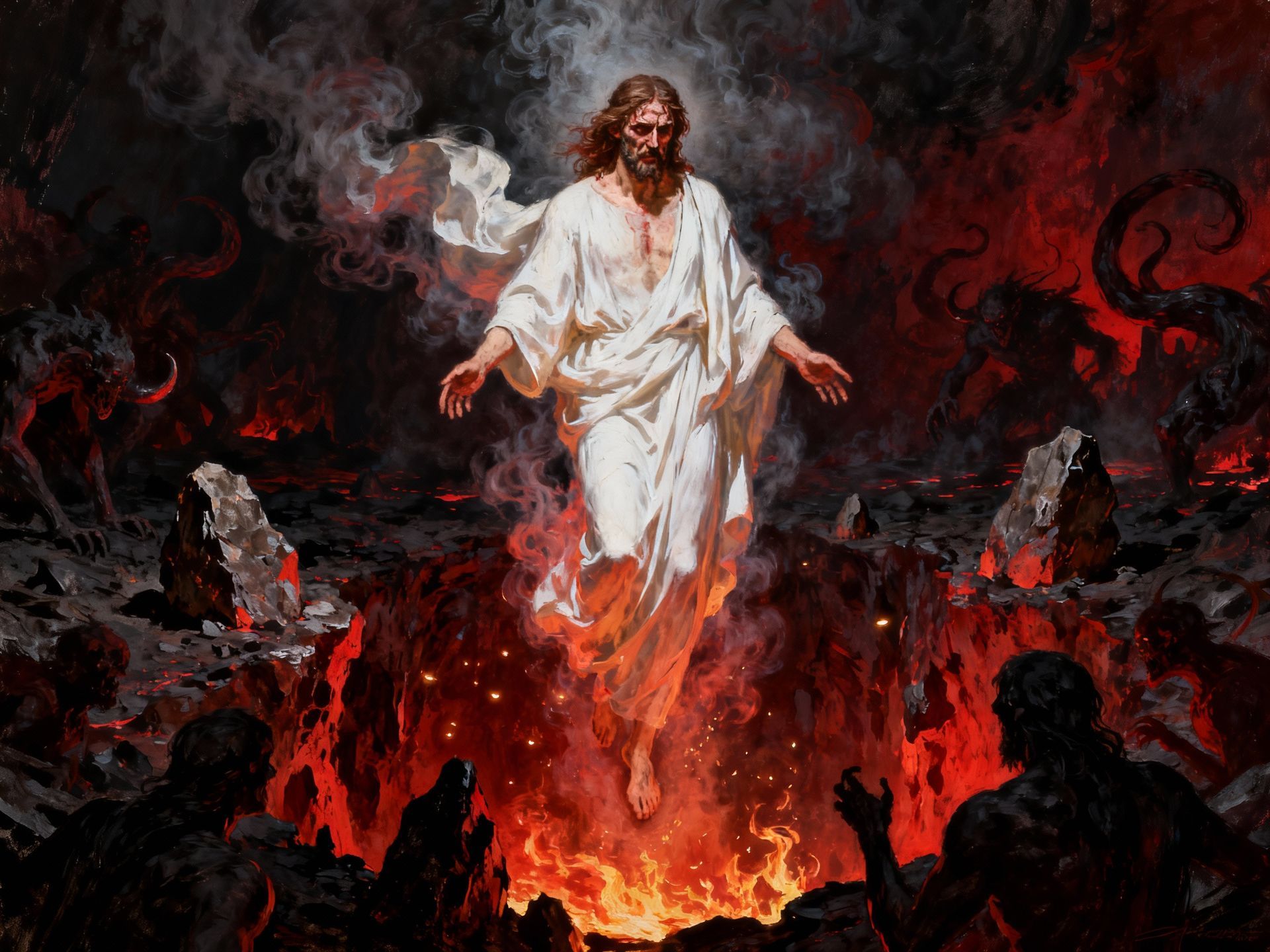
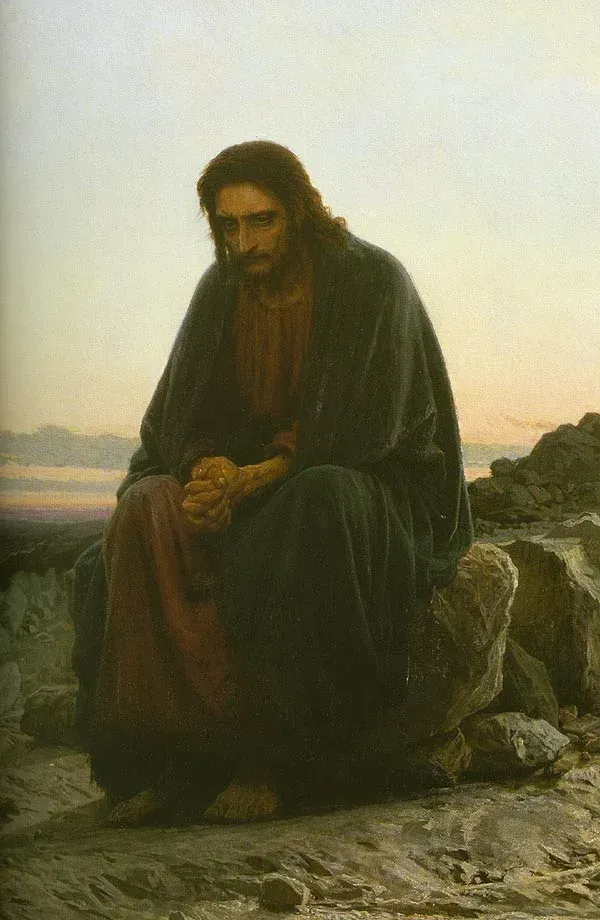
This was the descent Christ made after his crucifixion. Do you ever wonder where he was for those 3 days?
He was in Hell.
"He who journeys to Hell also becomes Hell; therefore do not forget from whence you come. The depths are stronger than us; so do not be heroes, be clever and drop the heroics, since nothing is more dangerous than to play the hero.” – C.G. Jung, The Red Book (2009)
Christ as Model of the Self
Numerous allusions are made throughout Gnostic and alchemical literature of Christ as the idealized form of the Self
– for the Gnostics it was the deity trapped in matter
that is revived through direct knowledge and experience of one self.
For the alchemists, Christ is the philosopher’s stone, the lapis, the goal of the work, that which is capable of transmuting all experience (perhaps especially suffering) into gold.
Through the process of taking on a divine task, meeting with the world, and letting it crucify you into your higher being – because the process is as painful as it is elative – you die to your former self and are reborn anew. This process takes time, patience, and clearness of awareness.
It will also unfold naturally within itself, and we must emphasize just briefly here that part - most - of awakening to our own “Resurrected Christ” is in the hands of the Unconscious.
To say it ultimately depends on us is to commit that grand hybris I mentioned earlier, putting our fragile egos in the place of God.
To meet with this deferently is to practice the compassion of Christ.
Modeling oneself on the Christ carries with it some dangers, all of which many of our fellow humans have fallen into. The preeminent one is that of identifying with the Savior,
making one’s process His process, what Christians often refer to as being “saved," or in the more secularized versions
of being virtue-obsessed
and self-defeating. This carries with it the inevitable human “frailness” which cannot measure to such an idol, along with its resultant sadomasochism.
Christ as the template does not mean to live a perfectly pure life, and submitting to Him as a savior is an escape.
Should there be discipline, some structure to our lives? Of course. Must we live perfectly and always be certain in our actions and their effects? Of course not.
Because what shines through in Christ is not simply His Godliness but his humanness.
It is always our humanness which leads, invariably, to our Godliness.
Christ had his karma. You have yours.
"To say it ultimately depends on us is to commit that grand hybris I mentioned earlier, putting our fragile egos in the place of God. To meet with this deferently is to practice the compassion of Christ."
This is where the esoteric instruction becomes so crucial, because there is no one that can tell you what is going to come alive in your inner experience, what your particular path will look like.
Like Christ, you bear a Kosmic destiny, and as alchemy teaches us – the stone is always present!
It may take lifetimes to burn off the cruder forms and reveal the prima materia, similar to the Hindu idea of karma.
You cannot come to understand your Christ nature if your comparisons ubiquitously trend towards describing Him in terms of everything you are not.
Spirit demands variety, not uniformity.
The aspect of Christ’s compassion should always be emphasized, so often lost in the clamor of mass mindedness. Whoever preaches hatred in Christ’s name has not yet accepted His compassion for themselves.
There are still many dark reaches to explore, and for this we must take full account and responsibility. What’s more, we must learn to willingly be that which we deny, not as an exercise, but as a whole hearted embrace of the many territories and peoples of our inner kingdom.
Rekindling the Divine Word
All of this language of Christ as the Self, conscious suffering, making the descent to Hell/the Underworld, all of it sounds… well, esoteric. In our modern world in which the archetypal energies have lost our respect and validity, we are apt to reject such religious sounding nonsense. We make the incredible mistake that our forebears were competent in other ways but that they did not have the divine gift of rational sense and scientific objectivity that we enjoy so naturally today. We, of course, do not see the course of history and the myriad magical spells which were cast in order for it to be natural for us to look at a world of “stuff” rather than a world of “spirits.”
And we certainly do not see how palely our competence compares to those of our ancestors.
Thankfully for us there was a modern person who recognized full well what the ancients knew, and was chosen by the Unconscious to take on a most arduous task. He accepted and built a conduit from the past into the present, cloaking a living Western esoteric tradition
and grafting it skillfully into modern culture with all the skill and dexterity of a lifelong botanist.
His name was Carl Jung.
The Sentient Soul

Learn why dream dictionaries often miss the deeper meaning of dreams and discover a Jungian approach to interpreting dream symbols and active imagination.

Discover the meaning of recurring dreams through a Jungian lens. Learn why recurring dreams and nightmares happen, what they reveal, and how dreamwork supports healing.